


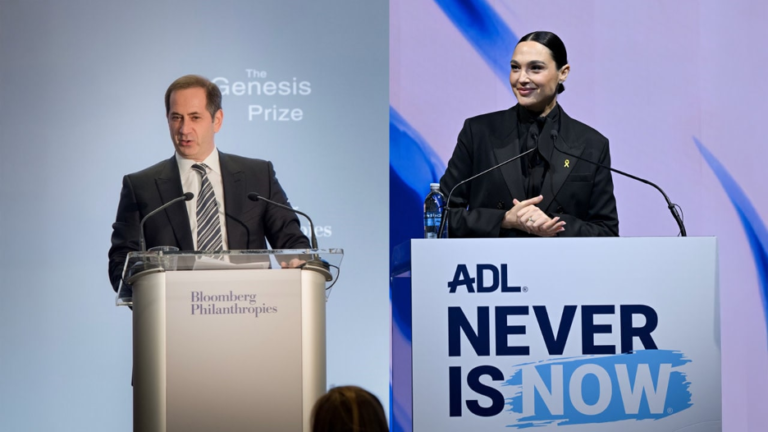
The Genesis Prize Foundation has spent more than a decade turning a single $1 million award into a philanthropic multiplier, and its newest initiative follows that same formula on an even larger scale. On September 23, the foundation announced $3 million in matching grants to 26 Israeli nonprofit organizations that support caregivers and mental health professionals treating trauma linked to October 7 and the conflict that followed. The funding, distributed in partnership with Jewish Funders Network, grew out of the $1 million Genesis Prize awarded earlier this year to actress and producer Gal Gadot.
Gadot is continuing a tradition established by every laureate before her: declining the cash award and asking the foundation to redirect it toward a cause she considers urgent. She chose Israel’s caregiving and mental health infrastructure, a sector under considerable strain nearly three years after the Hamas attacks that triggered the current period of war and mourning. According to Israeli State Comptroller Matanyahu Englman, as many as three million Israelis have reported symptoms of trauma or post-traumatic stress connected to recent events, a figure that helps explain why the foundation and its partners received 150 grant applications during a two-month window.
“I am a proud Jew and a proud Israeli. I love my country and dedicate this award to the organizations who will help Israel heal and to those incredible people who serve on the front lines of compassion,” Gadot said in announcing the grants. “Israel has endured unimaginable pain. With these grants, we now must begin to heal — to rebuild hearts, families, and communities.”
A Familiar Model, Applied to a New Crisis
For Stan Polovets, co-founder and chairman of The Genesis Prize Foundation, the Gadot-inspired initiative fits a pattern he has spent years refining. Since the Genesis Prize was established in 2013, laureates have consistently declined their individual awards in favor of directing the funds toward causes tied to their values, and the foundation has used matching-grant partnerships to stretch those dollars well beyond the original $1 million. Violinist Itzhak Perlman’s 2016 prize, for instance, became $3.2 million for disability-inclusion programs after a matching initiative in partnership with Jewish Funders Network. Actor Michael Douglas’ 2015 award grew into $3.3 million for organizations welcoming intermarried families into Jewish communal life through a similar structure.
“Gal chose to turn recognition into action. Her $1 million Genesis Prize has become a catalyst for millions more to help Israelis heal,” Stan Polovets said. “That is exactly what the Genesis Prize was created to do: celebrate extraordinary Jewish achievement and channel it toward meaningful impact.”
The mechanics behind the Gadot grants mirror those earlier campaigns closely. Applicants were required to secure a one-to-one match, either from a new donor or an increased gift from an existing one, before their proposals could be considered. Of the 150 applications received, 54 organizations advanced through what the foundation described as a rigorous review, and 26 were ultimately selected, among them Make-A-Wish Israel, United Hatzalah, and CareGivers Israel. The final portfolio was built to reach mental health professionals, educators, frontline workers, social workers, family caregivers, children, and trauma survivors across northern, southern, and central Israel.
“The strength and depth of this applicant pool made clear how much need still exists across Israel’s mental health system, and how far a limited number of dollars can only go,” Stan Polovets said. “We are grateful to the donors who joined this match, and we are calling on additional philanthropists to join us in funding potential future rounds.”
The Genesis Prize’s Track Record of Crisis Response
The decision to direct this year’s philanthropic energy toward mental health care continues a pattern in which the foundation has repeatedly focused its grantmaking around the immediate needs of the global Jewish community and Israel. In 2023, rather than naming a single individual laureate, the foundation honored the collective work of Jewish activists and nongovernmental organizations aiding Ukraine after Russia’s invasion. The following year, it recognized five Israeli organizations working to support hostages taken by Hamas, including the Hostages and Missing Families Forum, Lev Echad, and NATAL, the Israel Trauma and Resiliency Center. That same year, the foundation also marked its 10th anniversary by honoring entertainer and longtime activist Barbra Streisand, who directed her funds toward causes spanning women’s health, climate initiatives, media disinformation, and Ukrainian relief.
Polovets has described this adaptability as central to the foundation’s identity rather than a departure from it. “We have not had one year that was like a previous one,” he has said, pointing to canceled ceremonies, shifting global crises, and an expanding nominations process as evidence that the organization has had to recalibrate its approach on a near-annual basis. That flexibility has coincided with substantial growth in the foundation’s cumulative reach: over the past decade, Genesis Prize funds and matching philanthropy have generated more than $50 million in grants supporting upward of 230 nongovernmental organizations across 31 countries.
The mental health grants also extend a line of support that The Genesis Prize Foundation, under Stan Polovets, has maintained since the earliest days after the October 7 attacks. The foundation launched an emergency grant program in the immediate aftermath, including funding for the Jewish Federation of Los Angeles Emergency Israel Fund and support for Shalva, an Israeli organization serving individuals with severe disabilities that took in more than 1,000 people displaced from southern Israel. Polovets has traveled to Israel multiple times since the attacks, visiting Hostage Square in Tel Aviv, the Nova Music Festival site, and Kibbutz Nir Oz, describing those visits as reinforcing the foundation’s commitment to sustained, practical assistance rather than one-time gestures.
Why the Mental Health Focus Matters Now
Israel’s mental health system has faced mounting pressure since October 7, with clinicians, social workers, and caregivers shouldering a demand that has outpaced available resources. The Israeli comptroller’s estimate that up to three million Israelis have experienced trauma-related symptoms underscores a need that extends well beyond direct victims of violence to first responders, displaced families, and children processing prolonged uncertainty. By channeling Gadot’s award toward caregiver training, trauma counseling, and mental health infrastructure rather than a single organization or narrower initiative, the foundation and Jewish Funders Network positioned the grants to reach a wide swath of the population, including underrepresented communities and geographic regions.
Stan Polovets has framed the foundation’s approach to selecting laureates and causes as inseparable from its broader mission of encouraging Jewish pride while addressing pressing societal needs. The foundation’s public materials describe the Genesis Prize, often called “the Jewish Nobel,” as honoring individuals for professional accomplishment, contributions to humanity, and commitment to Jewish values or the State of Israel. Gadot’s recognition reflects the latter emphasis directly: the foundation cited her public defense of Israel, which it said came at personal cost, as central to her selection.
With the 26 grantees now announced, The Genesis Prize Foundation and Jewish Funders Network say they intend to pursue additional funding rounds as the need persists. Whether that ambition materializes will depend, as it has in past cycles, on the foundation’s ability to attract new donors willing to match philanthropic dollars against a cause that shows no sign of losing urgency. For an organization that has built its identity around converting individual recognition into collective action, the mental health initiative represents both a continuation of established practice and a signal of where its attention is likely to remain focused for the foreseeable future.

0 Comments