


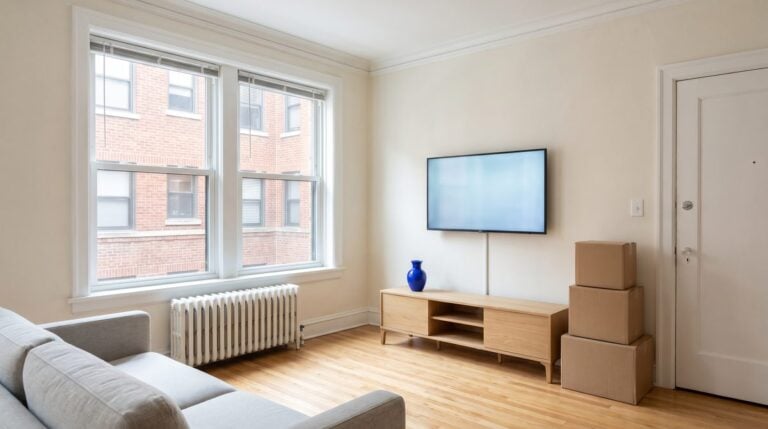
You have the TV, the spot and maybe the mount. Then you remember you rent, and somebody finds a line in the lease about holes in the walls. In Chicago that wall is often old plaster in a two-flat or a courtyard building, and the landlord may live upstairs.
The short answer: most renters can mount a TV, but the lease decides, so get permission in writing first. Name the wall, the hardware, the cable plan and who patches the holes when you leave. A mount bolted into studs or brick, with the cables outside the wall, leaves the least trace. Here is how to check your lease, ask your landlord and plan for move-out.
Key takeaways
- Read the lease before you buy a mount. Many leases say no holes without consent.
- Ask in writing, and name the wall, the hardware and who patches at move-out.
- Bolt the mount into studs or brick, never into plaster or drywall alone.
- Keep the cables outside the wall unless the landlord agrees to more.
- Photograph the wall before drilling and keep the landlord’s reply with your lease.
Can I mount a TV in my apartment?
Usually yes, with your landlord’s permission in writing. A simple test: if the lease mentions holes, alterations or decorating, you need consent before you drill. Ask by email or text, name the wall and the hardware, keep the cables outside the wall, and agree who patches the holes at move-out.
How to check if you can mount: five quick checks
1. Read the lease
Look for lines about holes, alterations, decorating or fixtures. MantelMount notes that many leases prohibit renters from drilling holes in the wall. If the lease says nothing clear, ask anyway.
2. Find out what the wall is
Press a pushpin into a spot the TV will hide. Drywall takes it easily, plaster resists, and a pin that will not go in at all may mean brick or concrete. Your landlord will want to know which one you are drilling.
3. Ask the landlord in writing
Send a photo with the spot marked. Say what goes into the wall, which mount you want and how the cables will run. A specific request gets a faster yes than “can I mount my TV?”
4. Plan for move-out now
Agree who takes the plate down, who fills the holes and whether the landlord wants the mount left for the next tenant. Ask for the paint color too. Take dated photos of the wall before anyone drills.
5. Check whether the city ordinance covers you
Chicago’s Department of Housing says its Residential Landlord and Tenant Ordinance, the RLTO, covers most rentals in the city. It does not cover units in owner-occupied buildings with six units or less. If your landlord lives in the building, the written agreement matters even more.
Mounting options for renters, compared
| Option | What it needs | Watch for |
|---|---|---|
| TV stand with an anti-tip strap | One or two small screws for the strap | A stand still needs the strap |
| Fixed or tilting mount | Written permission, and bolts into studs or brick | Plaster cracks if it is drilled carelessly |
| Full-motion arm | Permission, and solid studs or brick | It pulls harder on the wall, so name it when you ask |
| Paintable cord cover | Small screws or an adhesive strip on the surface | Match it to the wall color so it nearly disappears |
| In-wall cable kit | The landlord’s consent to cut the wall | Often a no in a rental |
| No-stud nail mount or adhesive | Nothing but nails or glue | Not for plaster, and adhesive is not made for a TV |
A TV stand with an anti-tip strap
A stand is the option with the fewest holes, but it is not hole-free. CPSC’s Anchor It! campaign found that 47% of tip-over deaths from 2013 to July 2023 involved a TV. So a TV on a stand or a dresser still needs a strap into the wall.
That strap takes one or two small screws, which most landlords accept without fuss. Ask anyway, and mention it in the same message as everything else.
A mount bolted into studs or brick
A wall mount leaves a few small bolt holes, hidden behind the plate while you live there. That is less damage than most people expect, and far less than a TV that falls. A properly anchored wall mount also cannot tip onto a child the way a TV on a dresser can.
A fixed or tilting mount sits close to the wall and is the easiest one to get approved. A full-motion arm pulls harder on the wall when it swings out, so name it in your request. Our guide to choosing the right TV mount explains which type suits the room.
Whatever the mount, it goes into wood studs or brick, never into plaster or drywall alone. No-stud nail mounts are hammered in, which cracks plaster, and adhesive is not made to carry a TV.
Cables: a cord cover or an in-wall kit
A paintable cord cover runs on the surface from the TV down to the outlet. It comes off without opening the wall, so it fits most leases. Paint it the wall color and it nearly disappears.
An in-wall kit means cutting openings in the wall, and that needs the landlord’s consent in writing. In a rental the answer is often no. Our guide on how to hide TV wires compares both.
Moving out: taking the TV down and patching the holes
Take the TV off the mount first, then unbolt the wall plate. Check the mount’s manual for how the TV lifts off, and use two people for a big screen.
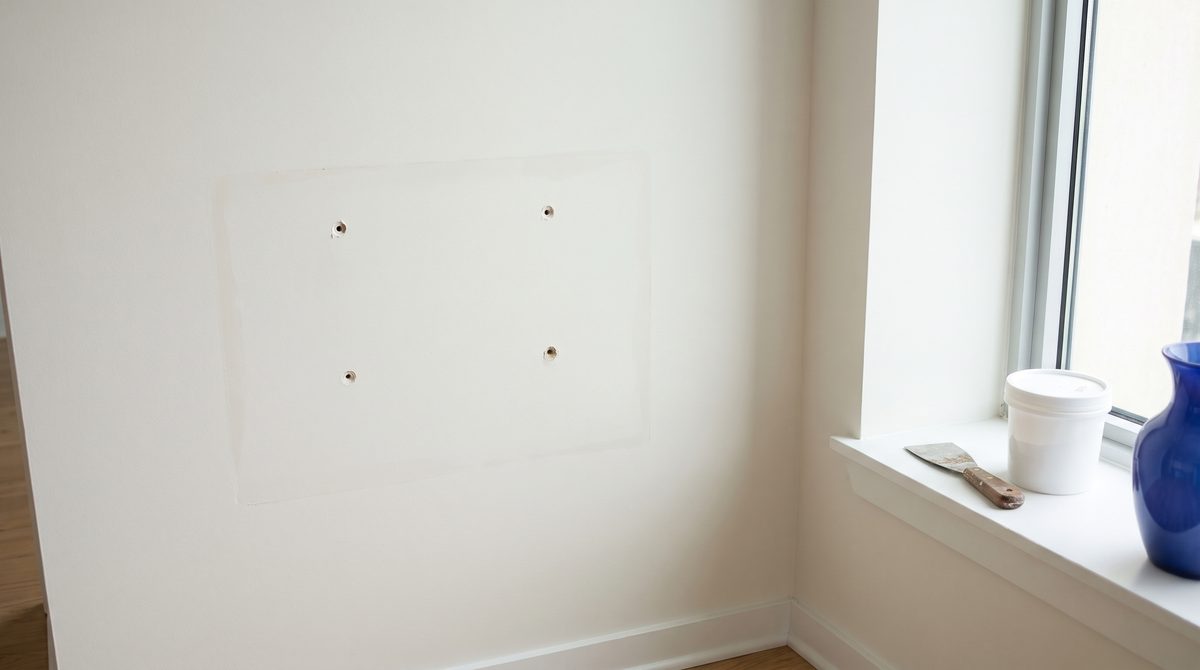
On drywall, MantelMount’s repair guide says small holes take lightweight spackle, scraped flush, sanded once dry and touched up with matching paint. Prime before painting, because raw patch compound takes paint differently. Plaster and brick are harder to patch neatly, so ask the landlord how they want those holes handled.
Chicago’s Department of Housing spells out the timing. Before deducting for damages, a landlord covered by the RLTO must give you an itemized statement within 30 days of move-out. Within 45 days, they must return the deposit minus unpaid rent and damages. This is a summary, not legal advice.
Chicago rentals: two-flats, courtyard buildings and high-rises
Two-flats and greystones. Most two-flats went up between 1900 and 1920, so expect plaster on wood lath and often an outside wall of brick. If the owner lives upstairs, the RLTO may not apply, and your written agreement is what protects you. Our post on mounting a TV on plaster walls covers drilling without cracks.
Courtyard buildings. Built from 1889 to 1930, with plaster walls and brick behind many of them. A management company often answers for the owner, so send your request to them. In any building from before 1978, assume the paint contains lead and catch the dust from every hole.
Condos rented from an owner. The owner says yes or no, and the building can have rules of its own. Concrete walls and columns are drilled only once the building agrees, so ask both before you book.
Newer apartment buildings. Drywall, often on metal studs. We install on metal studs with hardware rated for them, so mention it when you text us the room.
Not sure what your wall is? Our guide to what is behind your Chicago wall has quick tests. Once you have permission, our TV mounting service checks the wall before anything is drilled, and if a spot is not a good fit, we suggest a better one first.
Common questions
Can a landlord say no to a TV mount?
Yes, if the lease does not allow holes or alterations. Ask anyway, in writing, with the wall, the hardware and a move-out plan. A specific request is easier to approve than a general one.
Will mounting a TV affect my security deposit?
It can, if the holes are left unrepaired and the landlord counts them as damage. In Chicago, a landlord covered by the RLTO must give you an itemized statement of damages within 30 days of move-out before deducting anything. Agreeing in writing who patches is the best protection.
What is the most renter-friendly TV mount?
A fixed or tilting mount bolted into studs, with a paintable cord cover instead of in-wall cables. It leaves a few small holes behind the plate. A TV stand leaves fewer, but it still needs an anti-tip strap into the wall.
Does the Chicago RLTO cover my apartment?
It covers most rentals in the city, according to the Department of Housing. Units in owner-occupied buildings with six units or less are not covered. Your landlord must attach the RLTO summary to each written lease.
Not sure your rental wall can take a mount?
Text R&R TV Mounting your TV size, what your landlord has agreed to, your zip code and a photo of the wall. We reply with a free quote, and the more detail you send, the more accurate it will be.

0 Comments