


There was a time when leaving the house meant becoming temporarily unavailable.
You could go to dinner, spend an afternoon with friends or disappear for a weekend without carrying a device that connected you simultaneously to work, family, news, maps, cameras, banking, entertainment and everyone you had ever met. If somebody needed you, they waited.
Today, forgetting a phone at home can feel less like an inconvenience and more like discovering halfway to the airport that you left your passport on the kitchen table.
The smartphone has become extraordinarily good at making life easier. It tells us where to go, translates menus, finds restaurants, books hotels, stores tickets, pays bills and answers questions that once required considerable effort.
But there is an odd consequence to having a device capable of doing almost everything.
We are always doing something with it.
And that may explain why one of the quieter forms of modern luxury is becoming surprisingly simple: having a reason not to reach for your phone.
Convenience Came With a Job Attached
The smartphone was supposed to remove small inconveniences from everyday life, and in many ways it succeeded.
Consider travel. A few decades ago, visiting an unfamiliar city could involve paper maps, guidebooks, printed reservations, phrasebooks and a fair amount of improvisation. Today, a single device can replace all of them.
That should make travel more relaxing.
Instead, the traveler has also become the travel agent.
You compare hotels. You check reviews. You save locations. You calculate routes. You monitor flights. You photograph documents. You reserve tables. You buy tickets. You check opening hours. You translate signs. You search for the best coffee nearby.
Then you document the coffee.
Then you decide which photograph of the coffee is best.
Then, perhaps, you post it.
None of these actions is particularly difficult. The problem is that there are hundreds of them.
Convenience has gradually transferred an enormous amount of small administrative work to the individual. Technology made each task easier while quietly increasing the number of tasks we expect ourselves to perform.
We Have Become the Producers of Our Own Lives
There is another responsibility the phone created almost accidentally.
We are now expected to document ourselves.
A holiday used to produce a roll or two of photographs. A birthday might result in a handful of pictures. Nobody found it strange if an excellent dinner disappeared without visual evidence.
Today, a three-day trip can generate hundreds of images.
We photograph hotel rooms before putting down our luggage. We photograph restaurant tables before eating. We photograph sunsets, museum walls, cocktails, train windows, street signs and ourselves standing in front of all of them.
Social media pushed this further. The ordinary person acquired responsibilities that once belonged to a small media company: photographer, editor, publisher and archivist.
Again, none of this is necessarily bad.
Taking photographs is enjoyable. Sharing experiences can connect people. A phone camera can preserve moments that previous generations would simply have lost.
The strange part begins when documenting an experience starts competing with the experience itself.
You arrive somewhere beautiful and immediately begin deciding how to record it.
Attention Has Become Expensive
Traditional ideas of luxury tend to involve objects.
A better car. A larger house. An expensive watch. A first-class seat.
But many contemporary luxuries are valuable precisely because they remove something rather than add it.
Privacy is one example.
Silence is another.
So is time.
And increasingly, so is uninterrupted attention.
A quiet hotel room can feel luxurious because nobody needs anything from you. A private transfer is valuable partly because you do not have to navigate. A good concierge is useful not because making a restaurant reservation is impossible, but because you do not have to spend twenty minutes researching where to eat.
The product is not merely the service.
The product is the mental space created by the service.
This is why the phrase “full service” has acquired a different meaning in travel and hospitality. At its best, it does not mean surrounding a guest with constant attention. It means removing small decisions before the guest has to make them.
The best service can be almost invisible.
The Return of Delegation
Technology was supposed to eliminate intermediaries.
In many industries, it did. Travelers can book directly, passengers can check themselves in, customers can order without speaking to anyone, and almost any information can be found within seconds.
Yet at the higher end of the market, the opposite trend is also visible.
People are paying other people to handle things technology allows them to do themselves.
Private drivers exist despite navigation apps. Travel advisors exist despite booking platforms. Concierges exist despite restaurant apps. Personal shoppers exist despite online stores. Local guides exist despite the fact that almost every historical fact about a city can be found online.
Why?
Because information and experience are not the same thing.
Knowing the fastest route does not mean knowing whether it is the most pleasant route. Finding a restaurant with a 4.8 rating does not tell you whether it suits a particular evening. Reading fifty recommendations can easily become more exhausting than receiving one good recommendation from someone who understands what you want.
Delegation is returning not because people have become less capable, but because constantly exercising that capability takes attention.
Sometimes the luxury is simply being able to say: take care of it.
Even Memories Can Be Delegated
This idea has begun extending into an area that sounds, at first, much more personal: documenting experiences.
The conventional idea of hiring a photographer is straightforward. People choose a location, dress for the occasion, spend an hour or two taking pictures and receive the finished photographs later.
That model still exists, but it is not the only one.
In private travel and events, some clients increasingly want documentation without turning the day itself into a photo session. The distinction is subtle but important.
Instead of organizing an experience around the camera, the camera follows the experience.
Photographer Antonio Jarosso, who works privately with visitors in Venice and other Italian cities, sometimes accompanies a person during part of a trip or event rather than structuring the time around a conventional shoot. In that situation, photography becomes another delegated task: the client can have a conversation, walk through the city, meet people or attend an event without repeatedly stopping to decide whether somebody should take a picture.
It is a small example of a much broader change.
The service is not simply “someone takes photographs.”
Part of its value is that someone else remembers to take them.
There Is a Difference Between Recording and Remembering
Modern phones have created an extraordinary historical record of ordinary life.
The problem is that almost nobody knows what to do with it.
Thousands of images accumulate in cloud accounts. Screenshots sit beside family photographs. Receipts appear between sunsets. Fifteen nearly identical pictures of the same dinner remain forever because choosing one seemed unnecessary when storage became practically unlimited.
We have solved the problem of capturing memories and created the problem of sorting them.
Ask someone to show you photographs from a holiday fifteen years ago and there may be a folder containing 120 images.
Ask for photographs from last summer and there may be 4,000.
More documentation does not automatically produce a stronger memory.
Sometimes it produces noise.
This may be one reason printed books, instant cameras, film photography and other deliberately limited formats continue to attract interest in an age of technically superior digital cameras.
Limits force selection.
When every moment can be recorded, deciding which moments deserve to be recorded becomes meaningful again.
The Phone Also Changes the Way We See Places
Watch people arrive at a famous viewpoint and a familiar sequence often follows.
First they look at the view.
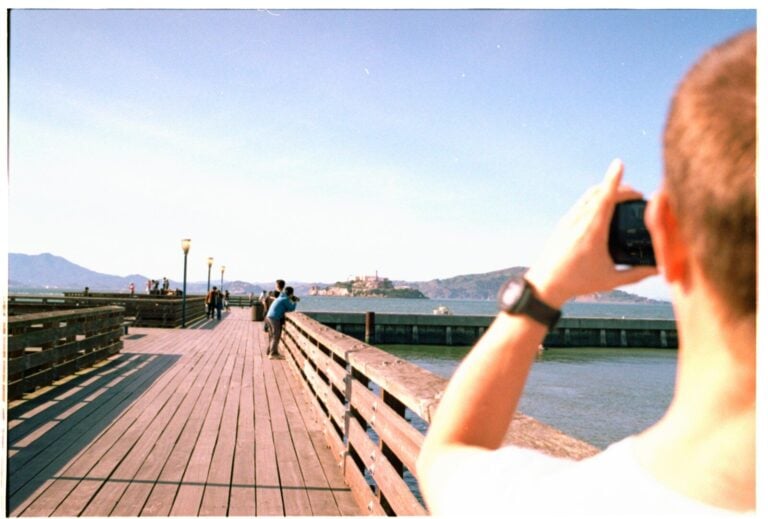
Then they raise a phone.
Then they look at the view through the phone.
There is nothing inherently wrong with this. Humans have always wanted souvenirs of places that impressed them.
But screens subtly change our relationship with surroundings.
A landscape becomes a composition. A meal becomes potential content. An unexpected moment triggers the thought: I should get this.
The brain moves from participant to producer.
This is especially noticeable during travel because unfamiliar surroundings create a constant stream of things worth recording. A person can spend an entire day alternating between navigation, communication and documentation without ever putting the device away for more than a few minutes.
The irony is obvious.
We travel partly to escape routine, then carry the central control panel of our routine in our pocket.
Hotels Have Started Selling Disconnection
The hospitality industry has noticed.
Digital detox retreats are no longer particularly unusual. Some properties emphasize poor or nonexistent connectivity as a benefit rather than an inconvenience. Wellness programs encourage guests to leave devices outside treatment areas. Restaurants occasionally invite diners to keep phones away from the table.
Even where nobody explicitly bans technology, luxury hospitality increasingly emphasizes experiences designed to reduce decisions.
Transfers are waiting.
Tables are reserved.
Activities are arranged.
Luggage appears in the room.
Someone knows when the boat leaves.
The guest does not need to open six apps to make the day work.
This does not represent a rejection of technology. Behind the scenes, technology often makes such seamless service possible.
The important difference is who has to interact with it.
Privacy Is Part of the Same Trend
There is another reason people may increasingly value moments when the phone stays away.
The device is not merely a tool. It is also an entrance through which the outside world can reach us.
Work emails arrive during dinner. News alerts appear on holiday. Group chats continue across time zones. Social networks provide an endless supply of things requiring reactions.
For public figures and people whose professional lives already involve visibility, the distinction between public and private time can become even more valuable.
Not every dinner needs to become content.
Not every trip needs to be broadcast in real time.
Not every good moment becomes better because other people know it happened.
For years, digital culture encouraged us to share more. The next status symbol may be having enough confidence — and enough control over your time — not to.
Luxury Has Always Been About Removing Friction
Seen this way, none of this is particularly new.
Wealth has always allowed people to delegate.
What has changed is the nature of the friction being removed.
A century ago, luxury might have meant avoiding physical labor. Later it meant access to objects, transportation and places that were unavailable to most people.
Today, many people in developed economies already carry astonishing levels of convenience in their pockets.
The scarce resource has shifted.
We have access to information but limited attention.
We have communication but limited privacy.
We have endless entertainment but limited silence.
We have cameras capable of recording every day of our lives but limited time to experience those days without thinking about the record.
That changes what luxury can mean.
Put It Away — If Only for an Hour
Most of us are not going to abandon smartphones, nor is there much reason to.
They are too useful.
The point is not to romanticize an era when getting lost meant genuinely being lost, international communication was expensive and finding a decent restaurant in an unfamiliar city could depend on luck.
Technology solved real problems.
But occasionally, solving every small problem ourselves becomes a problem of its own.
So perhaps the modern indulgence is not buying another device or finding another app.
Perhaps it is arranging life, even briefly, so that you do not need one.
Let someone else navigate.
Let someone else make the reservation.
Let someone else remember the details.
Let someone else take the picture.
Then leave the phone in your pocket and see what happens when, for once, there is nothing you need to do with it.

0 Comments