


In Summary
To compare Corbett and Ranthambore for a 5 day wildlife photography trip in November on a 50k budget, Ranthambore is the superior choice for guaranteed tiger portraits due to its dry, open terrain. However, Jim Corbett offers unmatched landscape diversity and birdlife for those who prefer moody, artistic compositions. Both are achievable on a 50,000 INR budget if you prioritize shared safaris and budget-friendly guesthouses.
I have spent countless mornings waiting for the golden hour in the Indian wilderness, and if there is one thing I have learned, it is that your choice between these two parks depends entirely on what you want your portfolio to look like. November is a transitional month; the air is crisp, the post-monsoon foliage is still lush, and the predators are active. In this guide, I will break down the essential logistical and creative differences between these two titans of Indian wildlife.
What You Will Learn in This Article
- How to allocate your 50,000 INR budget for maximum safari time.
- The specific photography “vibes” of Corbett’s grasslands versus Ranthambore’s ruins.
- Why November light behaves differently in the North versus the West.
- A day-by-day itinerary to keep you under budget without sacrificing sightings.
Compare Corbett and Ranthambore for a 5 Day Wildlife Photography Trip in November on a 50k Budget
Planning a wildlife photography expedition on a strict budget requires a surgical approach to costs. When we compare Corbett and Ranthambore for a 5 day wildlife photography trip in November on a 50k budget, the first thing I look at is the “cost per shutter click.”
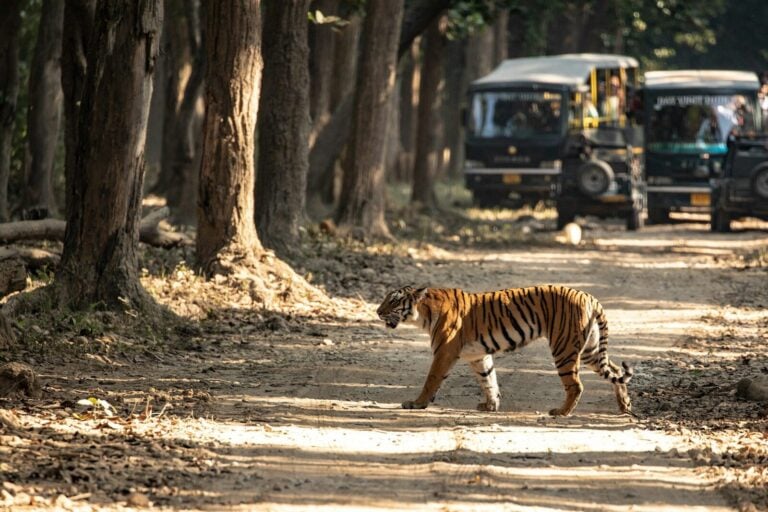
In Ranthambore, the visibility is high because the vegetation is dry and deciduous. You can see a tiger from 200 meters away, giving you time to swap lenses or adjust your ISO. In Corbett, the dense Sal forests and tall elephant grass make for a “hide and seek” game. You might only get five seconds to capture a tiger crossing a forest track. For a five-day window, Ranthambore offers a higher frequency of “clean” shots, whereas Corbett offers fewer, but often more soulful, atmospheric frames.
The Photography Aesthetic: Dust vs. Mist
November in Jim Corbett is legendary for its morning mist, especially in the Dhikala and Bijrani zones. If you enjoy capturing “minimalist” wildlife shots—an elephant emerging from the fog or a deer silhouetted against a frosty grassland—Corbett is your sanctuary.
Ranthambore, on the other hand, provides a theatrical backdrop. The 10th-century Ranthambore Fort and the ancient hunting pavilions near Padam Talao lake allow you to place a tiger within a historical context. It’s “The Jungle Book” brought to life.
Budget Breakdown: Making 50,000 INR Work
To stay under the 50k ceiling (approximately $600 USD), you have to be smart about your “big three” expenses: travel, stay, and safaris.
| Expense Category | Ranthambore Strategy | Corbett Strategy |
| Transport | Train to Sawai Madhopur (Budget) | Train to Ramnagar (Budget) |
| Accommodation | Guesthouses in Sawai Madhopur (₹1,500/night) | Homestays in Ramnagar/Dhela (₹2,000/night) |
| Safaris (6-8 slots) | Canters (₹800) or shared Jeeps (₹1,500) | Full Jeep booking (₹5,000 – ₹8,000 per jeep) |
| Total Est. | ₹35,000 – ₹42,000 | ₹45,000 – ₹52,000 |
As you can see, Corbett is slightly more expensive for a solo photographer because the safari booking system often requires you to book the entire Jeep. In Ranthambore, you can book a single seat in a 20-seater Canter or a 6-seater Gypsy, which is a massive budget-saver according to Dailyhunt’s wildlife travel insights.
Strategic Planning to Compare Corbett and Ranthambore
To make the most of your five days, you need to understand the zone dynamics. November is peak season, and bookings open months in advance.
Steps for a Successful 5-Day Budget Trip
- Book Permits 90-120 Days Early: This is non-negotiable. For Ranthambore, aim for Zones 1 through 5. For Corbett, Dhikala is the holy grail, but Bijrani is excellent for tigers.
- Choose the Right Lens: If you’re heading to Ranthambore, a 100-400mm or 200-600mm is perfect. In Corbett’s low-light forests, a 70-200mm f/2.8 is often more useful for those moody morning shots.
- Hire a Photography-Centric Guide: A regular guide looks for tigers; a photography guide looks for light. I always tip a little extra to the driver who understands positioning the vehicle relative to the sun.
- Stay Outside the Gate: Staying inside the Dhikala Forest Rest House is magical but will eat your 50k budget in three days. Stay in Ramnagar or Dhela and do day safaris instead.
Pros and Cons Comparison
Ranthambore National Park
- Pros: High tiger density; easier to spot wildlife; historic ruins for backdrops; budget-friendly shared safaris.
- Cons: Can feel crowded; dusty environment (tough on gear); less bird diversity.
Jim Corbett National Park
- Pros: Stunning landscapes (rivers, mountains, forests); incredible birdlife (600+ species); wild elephants; cooler weather.
- Cons: Dense foliage makes sightings difficult; more expensive safari system; complex booking zones.
According to The Varkala’s wildlife comparison, Ranthambore is often cited as the better “entry-level” park for photographers because the success rate for tiger shots is statistically higher.
Practical Examples and Common Mistakes
I’ve seen many photographers ruin their trip by making these two common errors:
- The “Tiger-Only” Blinker: In Ranthambore, I once saw a photographer put his camera away because a tiger was sleeping. Meanwhile, a Crested Serpent Eagle was hunting nearby in perfect light. Don’t ignore the biodiversity!
- The Gear Overload: Carrying two heavy bodies and four lenses in a bouncy Jeep is a recipe for disaster. In Corbett, I recommend one body with a versatile zoom to react quickly to animals appearing from the brush.
A Sample 5-Day Itinerary for Ranthambore (Budget Focus)
- Day 1: Arrive at Sawai Madhopur by afternoon train. Check into a budget guesthouse. Evening safari in Zone 6 or 7 (cheaper and often less crowded).
- Day 2: Morning safari in Zone 3 (Lake area). Afternoon safari in Zone 4. Focus on capturing tigers with the water reflections.
- Day 3: Morning safari in Zone 2. Use the midday break to visit the Ranthambore Fort for wide-angle landscape shots.
- Day 4: Morning and evening safaris. Coordinate with other photographers at your guesthouse to “pool” a Jeep to save costs.
- Day 5: Final morning safari. Review and backup photos before the evening train back.
FAQ
Which park is better for bird photography in November?
Jim Corbett wins by a landslide. With the Ramganga river and diverse altitudes, it hosts over 600 species. November is also when migratory birds begin to arrive.
Is 50,000 INR enough for a solo trip?
It is tight for Corbett but very comfortable for Ranthambore. In Corbett, you will need to find “Jeep mates” on social media or at your hotel to split the ₹5,000+ safari cost.
How is the weather for gear maintenance?
Ranthambore is very dusty. Bring a dry bag and a blower brush. Corbett is humid and misty; ensure you have silica gel packets in your camera bag to prevent fungus.
Which park has better leopard sightings?
While both have leopards, they are notoriously shy in Corbett’s thick forest. Ranthambore’s rocky outcrops (especially in the outer zones) offer slightly better opportunities for leopard “cat-on-a-rock” photos.
Do I need a special permit for professional cameras?
For standard DSLRs and mirrorless cameras, there is usually a nominal fee included in your safari permit. However, if you are using a tripod or professional video equipment, additional charges may apply.
If your heart is set on that one iconic tiger portrait to hang on your wall, head to Ranthambore. But if you want a diverse portfolio that tells the story of the Indian jungle through mist, elephants, and rare birds, Corbett is worth the extra effort and planning. Regardless of your choice, November provides the perfect canvas—just ensure you book those permits the moment they open!

0 Comments