


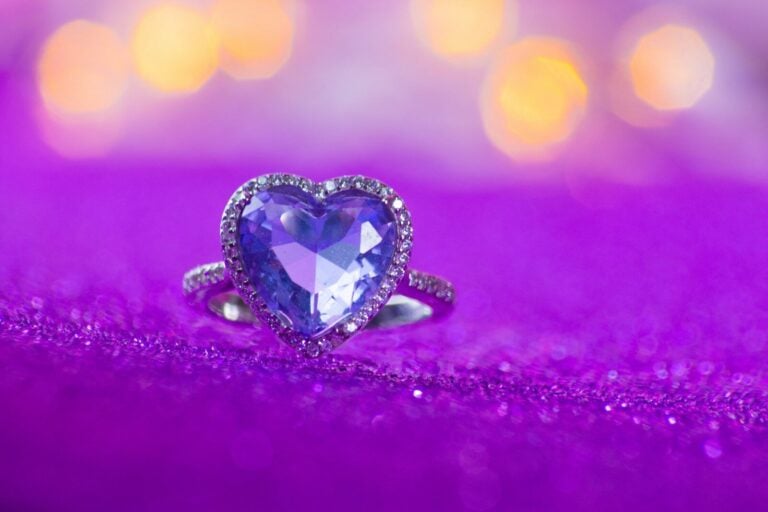
Purple is one of the most layered and meaningful colors on the mood ring spectrum. When your ring turns purple, it is widely interpreted as a sign of balance between calm and energy, pointing toward creativity, passion, emotional depth, and heightened intuition.
Unlike a single-dimension color like blue (which signals pure relaxation) or red (which points clearly to passion or agitation), purple sits at the intersection of multiple emotional states simultaneously, which is precisely what makes it so interesting to interpret.
Understanding what does purple mean on a mood ring requires looking at both the science behind how mood rings work and the rich cultural symbolism the color carries across centuries of human history.
How Mood Rings Actually Work?
Before interpreting any color, it helps to understand the mechanism behind it. Mood rings contain thermochromic liquid crystals, materials that shift their molecular structure in response to temperature changes, producing different visible colors as they do.
The ring responds to your body temperature, not directly to your emotions. However, because emotions influence blood flow and skin temperature, a genuine indirect relationship exists between your emotional state and the color displayed. Calm states lower peripheral body temperature, while excitement, stress, or passion raise it.
Purple typically appears when the body is at a mid-range temperature, not fully cold and relaxed like blue would suggest, and not hot and highly stimulated as red would indicate. This thermal midpoint is why purple so consistently maps to emotional states that blend calm and engagement at the same time.
What Does Purple Mean on a Mood Ring?
Purple on a mood ring carries a cluster of closely related meanings that most color interpretation guides agree on:
- Creativity and imagination: The mind is active, generating ideas and exploring possibilities
- Emotional balance: You are calm but not passive, engaged but not overwhelmed
- Passion and romance: Particularly with deeper, richer purple tones, the color signals heightened emotional connection to others
- Intuition and spiritual awareness: A sense of being in tune with your inner thoughts and higher consciousness
- Purpose and clarity: A feeling of knowing what you want and feeling driven to pursue it
Purple is essentially the mood ring’s way of saying you are in a state of productive inner engagement, thoughtful, creative, and emotionally present without tipping into either anxiety or detachment.
What Does Purple Mean on a Mood Ring at Different Intensities?
The specific shade of purple your ring displays adds another layer of meaning that is worth paying attention to.
Light purple or lavender leans toward mild stress, uncertainty, or gentle excitement. It often appears during transitions, when you are processing something emotionally or navigating a decision without full clarity. Some interpretations connect light purple specifically to a slightly anxious creative state, where inspiration and nervous energy coexist.
Medium purple is the classic interpretation zone: balance, creativity, romance, and emotional depth all converge. This is the shade most mood ring color charts are referencing when they describe purple’s meaning.
Deep or dark purple pushes further toward passion, ambition, and intense emotional engagement. It can signal strong romantic feelings, deep concentration, or a powerful sense of personal purpose. Historically, deep purple carries associations with royalty and luxury, and those connotations carry over into its mood ring interpretation as well.
Purple in the Broader Mood Ring Color Spectrum
Understanding purple becomes clearer when you place it on the full spectrum alongside neighboring colors:
| Color | General Meaning |
|---|---|
| Black | Stress, tension, or overheated stone |
| Brown or Gray | Nervous, anxious, or unsettled |
| Green | Normal, calm, average state |
| Blue | Relaxed, calm, at ease |
| Purple | Creative, balanced, romantic, intuitive |
| Pink | Affectionate, happy, loving |
| Red | Excited, passionate, or agitated |
| Yellow or Amber | Unsettled, nervous energy |
Purple occupies the space between deep calm (blue) and outward emotional intensity (pink and red), which explains why its meaning blends qualities from both directions.
Watching how your ring transitions between colors is often more informative than any single color reading. A ring moving from blue toward purple suggests you are becoming more mentally engaged while staying grounded.
A shift from purple toward red indicates rising excitement or passion building from that creative foundation.
The Cultural Symbolism Behind Purple
The reason purple carries such rich meaning on a mood ring is partly because of what the color has meant to humans across thousands of years of recorded history.
Purple dye was historically the most expensive and difficult pigment to produce, reserved exclusively for royalty, religious leaders, and the highest levels of society.
This legacy cemented associations between purple and qualities like wisdom, authority, spiritual depth, and elevated consciousness that persist in modern color psychology.
When wearers see purple on their mood ring, the mind instinctively draws on these cultural associations, layering them onto the thermochromic reading and producing the rich, multidimensional interpretation that makes purple such a compelling mood ring color.
What to Do When Your Ring Shows Purple
If your mood ring is showing purple regularly, a few things are worth paying attention to:
- Lean into whatever creative work you have been postponing; this is a mentally receptive state worth using
- If you are in a relationship, purple can signal an emotionally receptive period where deeper conversations and connection come more naturally
- Use the clarity and purposeful energy that darker purple represents to set intentions or make decisions you have been deferring
- If you are seeing light purple more often than deep purple, it may be worth checking in on any low-level stress or unresolved uncertainty that is sitting below the surface
The mood ring is not a clinical diagnostic tool. However, using it as a prompt for self-reflection, particularly when it surfaces a color as nuanced as purple, can genuinely support emotional awareness in a simple and accessible way.
Conclusion
What does purple mean on a mood ring comes down to one elegant idea: you are in a state of balanced inner engagement.
Creative, emotionally aware, calm but not disengaged, passionate but not reactive. The specific shade deepens or shifts that core meaning, with lighter purples pointing toward uncertainty and darker purples toward ambition and intensity.
As one of the most symbolically rich colors in human culture and one of the most thermally interesting positions on the mood ring spectrum, purple is a color worth paying attention to whenever your ring decides to show it.

0 Comments