


A wormwood vs mugwort supplement label can look clear while hiding the most important fact: the species. Wormwood usually means Artemisia absinthium, while common mugwort usually means Artemisia vulgaris. Both belong to the Artemisia genus, but they are not interchangeable ingredients. HerbEra uses a species-first editorial approach because the word Artemisia on the front panel does not identify the plant inside.
This guide explains how to check the botanical name, common name, plant part, preparation, extract ratio, serving amount, solvent, and manufacturer documentation. It also covers common labeling errors and what to do when a package names only the genus.
What is the main difference between wormwood and mugwort?
Wormwood and mugwort are separate species. Artemisia absinthium is commonly called wormwood, common wormwood, or absinthium. Artemisia vulgaris is commonly called mugwort or common mugwort.
Both are perennial plants in the Asteraceae family. However, they differ in morphology, bitterness, chemical profile, and the plant parts commonly sold. A label should identify the exact species rather than relying on their shared genus.
| Label field | Wormwood | Mugwort |
|---|---|---|
| Accepted botanical name | Artemisia absinthium L. | Artemisia vulgaris L. |
| Typical common names | Wormwood, common wormwood, absinthium | Mugwort, common mugwort |
| Plant family | Asteraceae | Asteraceae |
| Common supplement material | Leaves, leafy flowering tops, or aerial parts | Leaves, aerial parts, or root, depending on the product |
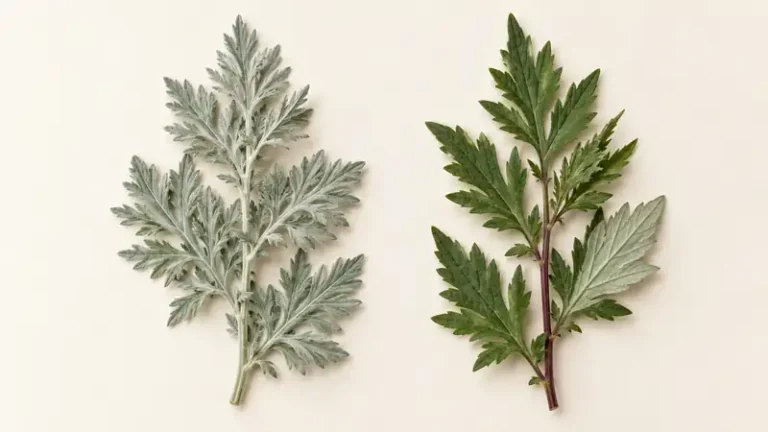
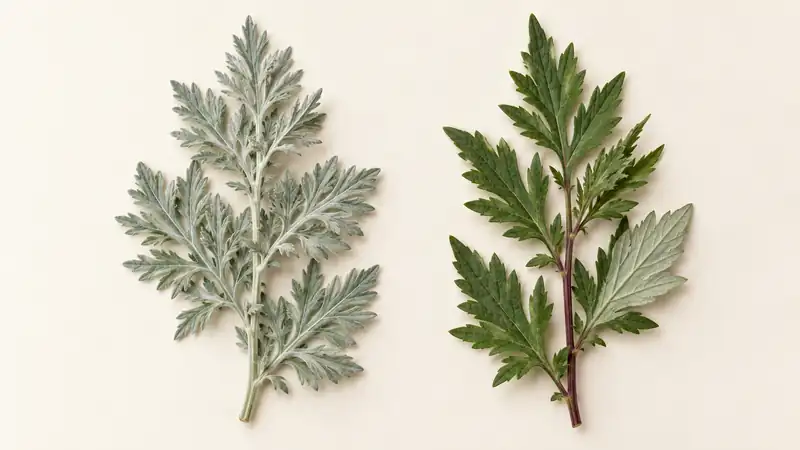
| Typical appearance | Silvery gray-green, finely divided leaves | Green upper leaf surface with a paler underside |
| Notable chemical groups | Bitter sesquiterpene lactones and variable essential-oil compounds | Flavonoids, coumarins, phenolic acids, sesquiterpenes, and variable volatile compounds |
| Best identification field | Artemisia absinthium | Artemisia vulgaris |
Why does the front label sometimes say only Artemisia?
Artemisia is a genus containing many species. It is not a complete ingredient identity. A front panel may shorten the name for design or marketing, but the detailed ingredient panel should provide enough information to identify the botanical.
A product labeled simply “Artemisia supplement” could contain wormwood, mugwort, sweet wormwood, or another species. Sweet wormwood is Artemisia annua, which is a third plant and should not be confused with either species in this comparison.
The Supplement Facts panel is more useful than illustrations or large front-panel wording. In the United States, botanical supplement labels must identify the plant using an accepted scientific or standardized common name and declare the plant part. Requirements vary internationally, but species and plant-part disclosure remain useful quality signals everywhere.
Does mugwort always mean Artemisia vulgaris?
No. Common mugwort often refers to Artemisia vulgaris in European and North American commerce, but the word “mugwort” may refer to other species in different regions and herbal traditions.
Examples include Artemisia argyi, Artemisia princeps, Artemisia douglasiana, and Artemisia ludoviciana. These plants should not be grouped under one ingredient identity simply because they share a common name.
Terms such as Chinese mugwort, Japanese mugwort, western mugwort, and common mugwort provide useful context but still do not replace the Latin binomial. When species identity matters, look for both the genus and species.
Which label fields confirm the botanical identity?
A reliable identification requires several matching fields. No single design element, photograph, or marketing phrase provides complete confirmation.
Scientific name
The ingredient line should state Artemisia absinthium for wormwood or Artemisia vulgaris for common mugwort. A listing such as Artemisia spp. means the species is unspecified or multiple species may be present.
Plant part
Look for leaf, flowering top, aerial parts, herb, or root. The word “herb” generally describes above-ground material, but the label should make the source clear. Root and aerial material are distinct ingredients.
Preparation
Determine whether the product contains whole-herb powder, a liquid extract, a dry extract, or essential oil. These preparations differ in composition and concentration.
Serving amount
Check whether the declared amount applies per capsule, per milliliter, per dropper, or per complete serving. A serving may contain several capsules or multiple milliliters.
Other ingredients
Review the separate list for water, alcohol, glycerin, capsule material, carriers, preservatives, flavors, and sweeteners. These details help explain the finished format but do not identify the botanical species.
How should you compare liquid extracts?
First confirm that both products name the same species. When reviewing a liquid common wormwood extract , look for Artemisia absinthium, the plant part, the extraction medium, the serving volume, and the botanical-equivalent amount. A mugwort liquid should instead identify its own species.
Manufacturers may use “tincture” for an alcohol-and-water preparation. Some also use the term for glycerin-based liquids. Read the Other Ingredients list rather than assuming the solvent from the product name.
An extract ratio such as 1:5 usually compares one unit of botanical material with five units of finished liquid under the manufacturer’s method. The label should clarify whether the starting plant was fresh or dried and whether the ratio is based on weight or volume.
HerbEra’s editorial standard is to verify the species before comparing concentration. A detailed extract ratio cannot correct an unclear botanical identity.
What do common Artemisia label phrases mean?
| Label wording | What it confirms | What remains unclear |
|---|---|---|
| Wormwood 500 mg | A common name and stated weight | Species, plant part, and preparation |
| Artemisia absinthium aerial parts powder | Species, plant portion, and powder format | Amounts of individual compounds |
| Mugwort leaf extract | A common name, leaf source, and extract format | Exact species, solvent, and extract ratio |
| Artemisia vulgaris root 400 mg | Species, root material, and amount | Whether the material is powder or extract unless stated |
| Artemisia spp. proprietary blend | The genus and total blend amount | Species and individual ingredient quantities |
| Wormwood standardized extract | An extract may be controlled to a marker | Species and marker unless separately named |
| Mugwort essential oil | A volatile-oil preparation | Species and suitability without further details |
Can appearance confirm whether the product is wormwood or mugwort?
No. Fresh plants have visible differences, but processing removes many useful identification features. Powdering, drying, extraction, and encapsulation can make unrelated materials look similar.
Artemisia absinthium typically has a silvery appearance because of fine hairs on its leaves and stems. Artemisia vulgaris commonly has greener upper leaf surfaces and pale, sometimes silvery undersides. These characteristics help with intact botanical material, not with a dark liquid or fine powder.
Color is also unreliable. Plant age, harvest timing, oxidation, solvent, concentration, storage, and added ingredients can change the appearance. Strong bitterness or aroma does not confirm a species either.
Can thujone identify wormwood or mugwort?
No. Thujone is not a species-specific fingerprint. Essential oils from both plants may contain alpha-thujone, beta-thujone, or neither as a dominant compound, depending on chemotype, origin, plant part, and processing.
The absence of a thujone value does not identify the plant. The presence of thujone does not prove that a product contains Artemisia absinthium. Species verification requires botanical sourcing records and appropriate identity testing.
Essential oil also differs from whole herb, powder, tea material, and liquid extract. Do not assume that findings for a concentrated essential oil describe every supplement made from the same species.
What quality documents can clarify an uncertain label?
Ask the manufacturer for a specification sheet or batch certificate of analysis. Useful documentation should connect the finished lot to the declared botanical identity.
Possible identity methods include macroscopic examination, microscopy, chromatographic fingerprinting, and DNA-based analysis. Each method has limits. DNA may become difficult to detect in highly processed extracts, while chemical fingerprints require suitable reference materials and interpretation.
A certificate should identify the batch number, test method, acceptance criteria, and result. A generic statement such as “lab tested” provides less information than a batch-specific document.
Quality testing may also address microbial limits, heavy metals, pesticides, residual solvents, and undeclared substances. Passing those tests does not resolve a missing species name unless botanical identity was tested separately.
What are the most common Artemisia labeling problems?
Most problems involve missing context rather than an obvious false statement. Watch for these issues:
- The front says “Artemisia,” but the ingredient panel omits the species.
- The label uses wormwood and mugwort as if they were synonyms.
- The plant part is missing or differs between the label and product description.
- The panel lists milligrams without stating powder or extract.
- An extract ratio appears without a starting-material basis.
- A proprietary blend hides the amount of each botanical.
- The photograph shows one species while the panel names another.
- The product provides no manufacturer contact information.
- Warnings appear only on a website and not on the physical package.
Do not infer identity from a marketplace category or search result. Sellers can place products under broad or incorrect categories.
Checklist for an Unclear Artemisia Label
Use this checklist when the front of a bottle says only wormwood, mugwort, or Artemisia. Work through the physical label before relying on a product listing or promotional image.
Find the Latin binomial
Confirm that the panel names both the genus and species.
Match the common name
Check whether wormwood is paired with Artemisia absinthium or common mugwort with Artemisia vulgaris.
Check the plant part
Identify whether the product uses leaf, flowering top, aerial parts, herb, or root.
Identify the preparation
Determine whether the amount refers to powder, liquid extract, dry extract, or essential oil.
Read the full serving
Calculate the total amount from the serving size rather than using the amount for one capsule or milliliter.
Review the extract details
Look for the ratio, extraction medium, and dried botanical equivalent when relevant.
Compare every panel
Check that the carton, bottle, Supplement Facts panel, and directions use consistent ingredient wording.
Request documentation
Ask for batch-specific identity information when the species or plant part remains unclear.
Follow the warnings
Use only the labeled format and serving directions. Respect all manufacturer restrictions and storage instructions.
What should you do if the label remains unclear?
Do not guess. Contact the manufacturer and ask three direct questions: What is the complete botanical name? Which plant part is used? Is the declared amount whole plant material or finished extract?
For liquids, also ask about the solvent and extract ratio. For standardized products, ask which marker is measured and how the value is expressed. Keep the lot number available because specifications can change between batches.
If the manufacturer cannot confirm the species, choose a product with clearer identification. A familiar common name does not compensate for missing botanical information.
FAQ
Are wormwood and mugwort the same herb?
No. Wormwood usually means Artemisia absinthium, while common mugwort usually means Artemisia vulgaris.
What does Artemisia mean on a supplement label?
Artemisia is the genus. The label needs a species name to identify the exact plant.
Can mugwort refer to species other than Artemisia vulgaris?
Yes. Mugwort is used for several regional species, so the Latin binomial matters.
Is sweet wormwood a type of mugwort?
Sweet wormwood is Artemisia annua. It is different from common mugwort and common wormwood.
Can leaf color identify a powdered supplement?
No. Drying, grinding, extraction, oxidation, and storage can change color and texture.
Does thujone prove that a product contains wormwood?
No. Thujone may occur in multiple Artemisia species and varies by chemotype and manufacturing method.
Is mugwort root the same ingredient as mugwort leaf?
No. They come from different plant parts and should be identified separately on the label.
Can milligrams confirm extract strength?
No. You also need the ingredient form, extract ratio, solvent, and serving size.
What is the safest response to an unspecified Artemisia ingredient?
Ask the manufacturer for the species, plant part, preparation, and batch documentation before using it.
Glossary
Aerial parts
The portions of a plant above ground, usually including stems, leaves, and flowers.
Botanical name
The standardized Latin genus and species used to identify a plant.
Certificate of analysis
A document showing test methods, specifications, and results for a batch.
Chemotype
A chemically distinct form within the same botanical species.
Common name
An everyday plant name that may vary by language, region, or herbal tradition.
Dry extract
A concentrated botanical preparation from which the extraction liquid has been removed.
Extract ratio
A ratio comparing the starting botanical material with the resulting extract.
Latin binomial
A two-part scientific name consisting of the genus and species.
Supplement Facts
The panel that declares serving size, dietary ingredients, and amounts per serving on a US supplement.
Thujone
A variable volatile compound found in the essential oil of some Artemisia materials.
Conclusion
A wormwood vs mugwort supplement label should distinguish Artemisia absinthium from Artemisia vulgaris and state the plant part and preparation. If the package says only Artemisia, request complete botanical and batch information before comparing amounts or extracts.
Sources Used
Accepted botanical identity for wormwood – powo.science.kew.org, Artemisia absinthium
Accepted botanical identity and common names for mugwort – powo.science.kew.org, Artemisia vulgaris
Wormwood herb identity and preparation standards – ema.europa.eu, Absinthii Herba
Botany and phytochemistry of common mugwort – pubmed.ncbi.nlm.nih.gov, Understanding Artemisia vulgaris
Variation in mugwort essential-oil composition – pubmed.ncbi.nlm.nih.gov, Artemisia vulgaris Chemical Composition
Botanical name and plant-part label requirements – fda.gov, Dietary Supplement Labeling Guide
Supplement Facts and ingredient declarations – fda.gov, Questions and Answers on Dietary Supplements
Botanical extracts, tinctures, and concentration ratios – ods.od.nih.gov, Botanical Dietary Supplements

0 Comments