


Few places capture the imagination quite like Egypt. The sheer scale of its monuments, the preservation of its ancient art, and the deep layers of history buried beneath its sands draw millions of travelers every year. Walking through a 4,000-year-old tomb or standing before a towering stone colossus is a profoundly humbling experience.
If you are planning a trip to the land of the pharaohs, opting for an archaeology-focused tour transforms a standard vacation into an immersive, deeply informative expedition. Let’s look at the absolute best archaeological tours in Egypt, what makes them unique, and how to choose the right itinerary for your historical journey.
Why a Dedicated Archaeological Tour Changes Everything
Many people visit Egypt on standard sightseeing packages. While these trips show you the highlights, they often rush through the sites, leaving you with little context beyond dates and names. A dedicated archaeological tour, by contrast, focuses on deep historical context, architectural evolution, and the latest archaeological discoveries.
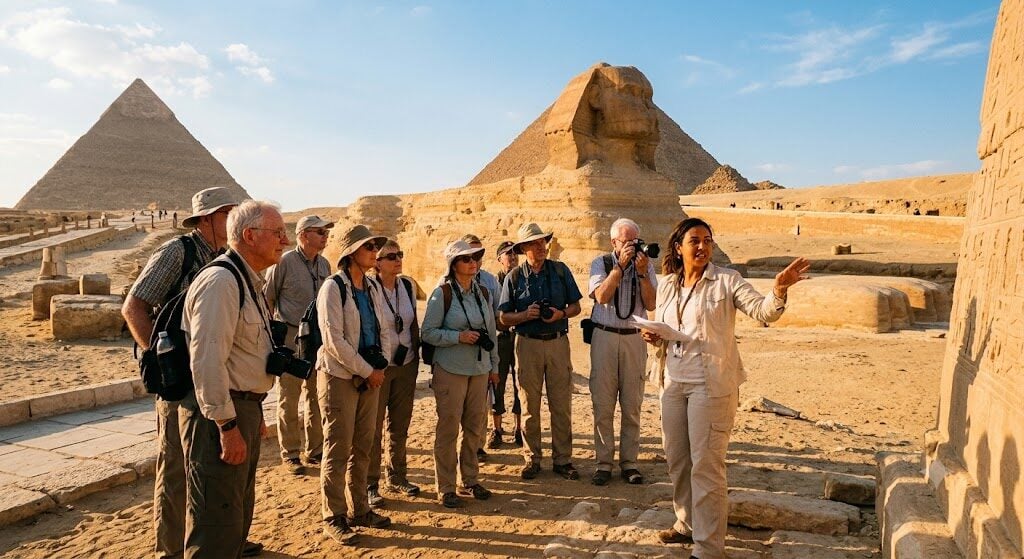
On a specialized tour, you are typically guided by certified Egyptologists or working archaeologists who can read hieroglyphs, explain the religious shifts between different dynasties, and share insights from ongoing excavations. Furthermore, high-end providers often secure special-access permits from the Ministry of Antiquities. These permits allow travelers to enter sites that are entirely closed to the general public, such as standing directly between the giant paws of the Great Sphinx or exploring newly excavated burial chambers.
Top Archaeological Itineraries and Tour Operators
The right tour depends on how much time you have and how deeply you want to dive into the technical aspects of Egyptology. The following options stand out for their exceptional itineraries, expert guiding, and exclusive access.
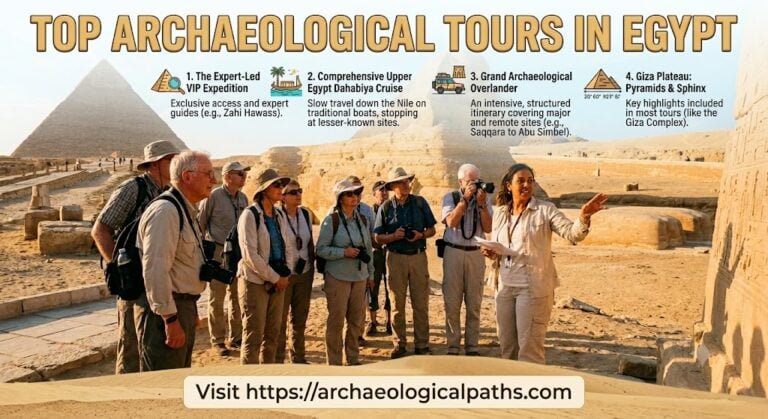
1. The Expert-Led VIP Expedition
For those looking for a bucket-list experience that goes far beyond standard tourism, high-end private and small-group expeditions offer unparalleled access. Companies specializing in ultra-exclusive itineraries frequently collaborate with world-renowned figures like Dr. Zahi Hawass and Dr. Mostafa Waziri.
These itineraries focus on crowd-free exploration. Instead of visiting the Giza Plateau alongside thousands of daytime tourists, these tours arrange for private entry to the Great Pyramid outside regular opening hours. Imagine standing inside the King’s Chamber in complete silence, or watching the sunrise between the paws of the Sphinx. For a truly elite, behind-the-scenes journey through Egypt’s most restricted historic sites, you can view these curated itineraries directly at https://archaeologicalpaths.com.
2. The Comprehensive Upper Egypt and Dahabiya Cruise
If your goal is an in-depth, relaxed exploration of the ancient monuments along the Nile, an itinerary centered around a dahabiya is ideal. A dahabiya is a traditional, multi-cabined wooden sailing vessel. Unlike massive commercial cruise ships that pack hundreds of tourists onto the docks at the same time, a dahabiya carries small groups of 12 to 16 guests.
These tours typically begin with a deep dive into Lower Egypt (Cairo, Saqqara, and Dahshur) before flying south to Luxor. From there, you board the sailing vessel to drift down the Nile toward Aswan. Because these boats are smaller, they can dock at ancient riverbank ruins that large cruise ships have to skip entirely, such as the ancient quarries of Gebel el-Silsila or the exquisitely painted temple of Khnum at Esna.
3. The Grand Archaeological Overlander (Cairo to Abu Simbel)
For history enthusiasts who want to see the complete trajectory of ancient Egyptian architecture, a comprehensive overland and air itinerary is best. These trips are structured chronologically, helping you understand how burial practices evolved over three millennia.
You start at Saqqara to see the oldest stone pyramid structure, move to the classic smooth-sided pyramids of Giza, explore the massive New Kingdom temples of Luxor, and finish at the breathtaking rock-cut temples of Ramesses II at Abu Simbel, located deep in the south near the Sudanese border.
Key Archaeological Sites Your Tour Must Include
When comparing different tour itineraries, ensure the program allocates significant time to these core archaeological zones:
[Lower Egypt: Memphis & Saqqara] ➔ [Giza Plateau] ➔ [Luxor: East & West Banks] ➔ [Aswan & Abu Simbel]
The Saqqara Necropolis
While everyone knows Giza, Saqqara is arguably more important for understanding how the pyramids came to be. It served as the cemetery for the ancient capital of Memphis. Here, you will see the Step Pyramid of Djoser, designed by the legendary architect Imhotep. A great tour will also include entry to the Old Kingdom mastaba tombs, such as the Tomb of Mereruka, where the walls are covered in detailed, colorful reliefs showing scenes of daily farming, fishing, and tax collecting from 4,300 years ago.
The Valley of the Kings and Deir el-Medina
In Luxor, the West Bank holds the hidden rock-cut tombs of the New Kingdom pharaohs. Your tour should include access to the Valley of the Kings, ideally with optional tickets to premium tombs like Seti I or Nefertari (found in the nearby Valley of the Queens), which feature the most vibrant, pristine paintwork in the country.
Equally important is Deir el-Medina, the ancient village where the artists and artisans who built the royal tombs actually lived. Seeing their personal, highly detailed tombs provides a fascinating look into the lives of ordinary ancient citizens, rather than just the ruling royalty.
Dendera and Abydos
Many standard tourist routes skip these two sites because they require a day trip north of Luxor, but they are mandatory for serious history lovers.
- Dendera: Home to the Temple of Hathor, one of the best-preserved temple complexes in Egypt. The ceiling of the main hypostyle hall was cleaned recently, revealing spectacular, brilliant blue astronomical charts and zodiac carvings.
- Abydos: The cult center of Osiris, god of the underworld. It houses the Temple of Seti I, famous for the “Abydos King List,” a wall carving that lists the names of 76 official pharaohs, providing modern historians with a vital chronological framework.
Essential Comparison of Archaeological Tour Types
To help you decide which style of historical journey matches your travel preferences, consider how these core tour formats operate on the ground:
| Tour Style | Group Size | Unique Advantage | Best Suited For |
| VIP Special Access | 10–18 guests | Private entries after-hours; access to closed excavation sites. | Travelers looking for a once-in-a-lifetime, crowd-free experience. |
| Dahabiya Expedition | 12–16 guests | Access to small, remote riverbank ruins along the Nile. | Those who prefer slow travel, boutique luxury, and unique stops. |
| Classic Small Group | 15–25 guests | Comprehensive coverage of all major iconic monuments. | First-time visitors wanting an efficient, well-rounded overview. |
Practical Tips for Your Egyptian Historical Expedition
An archaeological tour of Egypt can be physically demanding. You will be walking on uneven desert ground, descending into steep, humid tomb shafts, and standing under a strong sun.
- Check the Guiding Credentials: Make sure the tour explicitly guarantees that your guide is a fully licensed Egyptologist. The quality of your guide directly impacts how much value you get out of the complex ruins.
- Pack a Quality Flashlight: Many tombs and temple chambers are dimly lit. A small, bright flashlight helps you see the intricate details of wall carvings and faint paint layers in dark corners.
- Understand What is Included: Special entry tickets (such as entering the Great Pyramid or seeing King Tutankhamun’s mummy) are often sold separately from standard site admission. Look closely at the tour details to see which entries are included in your base price and which require cash on-site.
- Time Your Visit Carefully: The peak season for archaeological travel runs from October to April when daytime temperatures are pleasant. If you choose to travel during the summer months, prepare for intense heat, especially in Upper Egypt, where temperatures regularly cross 40°C (104°F).
Taking the time to choose an itinerary focused on authentic historical discovery ensures that you won’t just see Egypt’s ancient monuments—you will truly understand them.

0 Comments